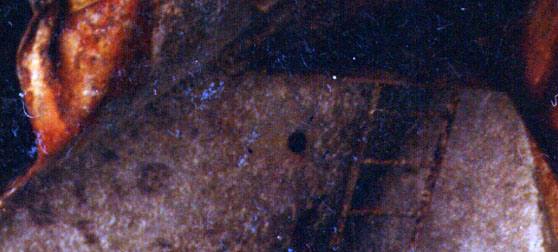
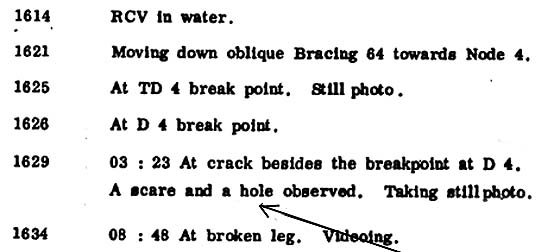
The Police and Commission gave conflicting explanations
for this hole of which none were convincing. Both explanations included,
however, that the hole was cut during the second uprighting operation as
the hole observed had a clean fresh cut.
Photo 6.2.8; Node 4: hole in bracing D4 enlarged.
Before sinking the rig in Nedstrandsfjorden permission
was obtained by the <<Kielland-foundation>> and the French
contractor CFEM to cut off the D4 bracing. The cut-off piece with D4 upper
breaking point was brought ashore. As part of an agreement with the French,
the Kielland-foundation had been given right to secure samples for material
testing of the D4 upper breaking point. It proved, however, that the D4
cut-off piece was to be shipped to France. The Kielland-foundations request
to Norwegian authorities to secure the cut-off piece as evidence was not
adhered to. The Commission paid no interest - nothing more was to be found!!!!
During inspection of the D4 cut-off piece at Randaberg dockside, representatives
of the Kielland-foundation in understanding with representative from CFEM
secured three steel samples refered to in the section on Technical Documentation
as "Reference Piece", "Rondel" and "Spiral".
By their own a larger test piece was secured which together with the "Reference
piece" were tested at Institute of Physics in Oslo in 1983/84. The
"Spiral" and "Rondel" were tested by Sintef in 1986.
2.1 Material testing of bracing
D4 upper breaking point.
The "Reference piece" was handed over by the
French engineer from CFEM as part of the agreement. The "Spiral"
and "Rondel" were found inside the cutoff piece cornered in and
covered by cuttings from the cutoff operation. The "Spiral" was
a fragment from the exploded D4 breaking point and the "Rondel"
cut out from the bracing wall making a hole. Both pieces had been captured
by the imploded upper D4 breaking point on the rig, see photos.
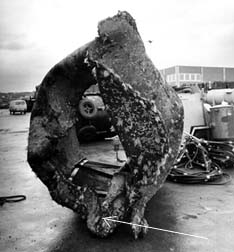
Photo 2.3.1 Bracing D4 cut-off piece on dockside.
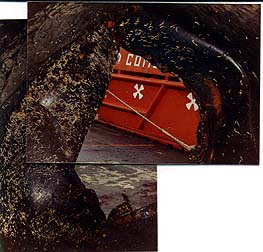
Photo 2.3.2 Bracing D4 cut-off piece from inside towards
the fractured opening
Due to the imploded opening of the D4 fracture, pieces firstly being captured within this part of the bracing have not been allowed to escape during uprighting. This fully explains the existence of the "Spiral" but not the "Rondel". On photo 2.3.1 is however shown a grating lying inside the cut-off piece. The grating is a platform mounted inside the bracing across the opening for inspection purposes. The platform was cut loose by the French for access purpose. The only explanation for the "Rondel" is that by cutting a hole in the bracing from outside the "Rondel" falling down inside the bracing has landed on the inspection platform and subsequently been captured by the imploded D4 fracture together with the "Spiral".
The cut side of the "Rondel" is rough which
indicates that the job is done under not favorable conditions, windy, unstable
or by a nonprofessional.
Photo 2.3.5: The D4 "Rondel" test piece
The hole as discovered during inspection on Oct. 13th 1983 had however a clean cut shape.
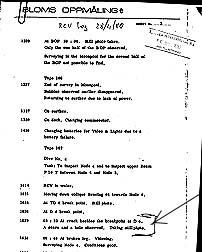
Later Bloms Oppmåling's log from underwater survey
of the rig on April 28th 1980, was made available by the representative
from CFEM. The log reports a hole in the D4 bracing conected to the rig.
Im. 6.2.9.1: Bloms Oppmåling's
Underwater Inspection Log of 28.04.1980
Im. 6.2.9; Bloms Oppmåling's Log of 28.04.1980,
enlarged.
The video from this underwater survey should be in the posession of Storebrand representing the insurance companies.
There was no hole in the D4 cut off piece except from the square hole for fixing the lifting gear during cut-off. The "Reference" piece came from this hole.
It is most likely that the sircular hole discovered during inspection on Oct. 13th 1983 is the same hole as recorded during underwater inspection on April 28th 1980. It is also likely that the "Rondel" comes from this hole. In such case the hole has been manipulated - cleaned up - during or after the second uprighting attempt.