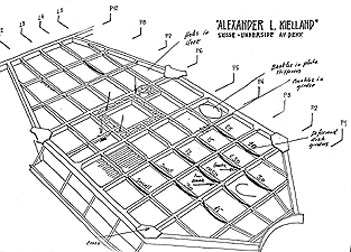
An underwater survey was performed on the capsized Alexander L. Kielland rig in order to assess the structures ability to wothstand the loads imposed on it during uprighting. The survey was performed by Det norske Veritas (DnV) for the Oil Risk Pool in 1981. The Norwegian insurance company Storebrand was in lead of the Oil Risk Pool. The methods used and summary of findings are presented in DnV Technical report no. 81-829 "Diving Survey of A.L.K. Preliminary Report.
Findings:
In the deck area several of the longitudinal girders are deformed. Fig 5.1 shows the deck area with the damages sketched in. Maximum deformation is given on the figure. The fig is copied from the DnV report. Several of the corrugations/plate stiffeners on the underside of the deck (when floating in upright position) are deformed in the same manner and in the same area.
There are found several holes in the deck. During the first uprighting attempt in 1980 the BOP was removed from the rig. It was rested a few times on deck for rehooking of straps before lifting to the surface. The deck is marked by this. In addition to insigninificant damage due to this there were several holes in the deck that cannot be explained by rough BOP handling.
One hole is reported to be large enough to allow a diver to put his arm inside.
Fig 5.1 Damage underside deck. D-leg imaginary up to right corner on figure.
DnV has not in this report commented on the causes to the damages. Cause are delt with in a separate report no. 81-0644 entitled: "Evaluation of causes and consequences of damages discovered by underwater inspection of A.L.K. in the period July/August 1981". That report focuses on deformation of girders being caused during the first uprightning attempt in 1980 by the buoyancy bags fitted to the structure.
Discussion:
The reason for the damages given in DnV report 81-0644 is disputable. In
their preliminary report DnV states:
"It appears that the deck first has been deformed violently upwards lifting and deformig the web whereafter the deck has been pulled down with sufficient force to rip it like a sheet of paper."
Further ..."there were several holes in the deck that cannot be explained by rough BOP handling."
The situation described fits with what happens as result of an explosion inside bracing D4. Fragments from the explosion hits and damages (holes) the deck and exposed lifeboats. Further the shock wave from the explosion hits the deck and the water, and blows a creater into the sea with seavawe splashing up underneath the deck lifting it up distorting the webs wherafter the seawave collapses and the deck falls down and hits the wateragain. This due to the broken away D-leg as the seawave hits the D-leg and pushes the leg appart from the platform with waterrunup ripping the lifeboat hanging on the D-leg of its fixings.
This situation also corresponds with statement from the survivors. Dependent on their location onboard the platform when the platform collapsed they have noticed one,two or three "waves" hitting the deck. The first wave is likely the airshockwave from the explosion. The second wave is the watersplash hitting the deck and the D-leg pushing them apart, and the third wave is when the deck falls down and hits the water.